26 January, 2026

Let the Summer Cruise begin – Summer? Bass Strait Crossing

Let the Summer Cruise begin – Summer?

After returning from the tropical north of Queensland in 2023, I contemplated a cruise to Tasmania. Malua had been there twice previously, and a round Van Diemen's Land cruise would just be the ticket for a late summer cruise in company, so I put the money down and booked a spot in what I thought was a few months' time, restricted to about 30 vessels.

Did I get a surprise when I started in December to prepare and check the safety requirements and equipment needed. The cruise was not months away but years away. Yes, February 2026.

That was a disappointment, but it gave me time to prepare Malua for the cruise. However, in February 2025 I got a call from a very good sailing companion who I had never sailed on this boat with, but we had covered many miles from the Med, Atlantic, USA and finally the Pacific and home together. His request was simple: there is a short window of opportunity to cross Bass Strait, would I come with him on the passage? The answer was simple and I jumped at the opportunity.

You can read the account above (earlier post) "Was that a dream…"

2026 finally dawned and I started to again intensely study the weather. This time it was my turn to take a friend for the passage. I had stated I would leave Bermagui when the first high formed in the Tasman after the full moon of 3 January. He scheduled many activities both at home and in Tassie on my throwaway line.

The weather cooperated much sooner than I had expected, so there was a final rush from the coast back to Canberra to try to get everything done prior to the early weather window opening, which it did on the 6th of January 2026.

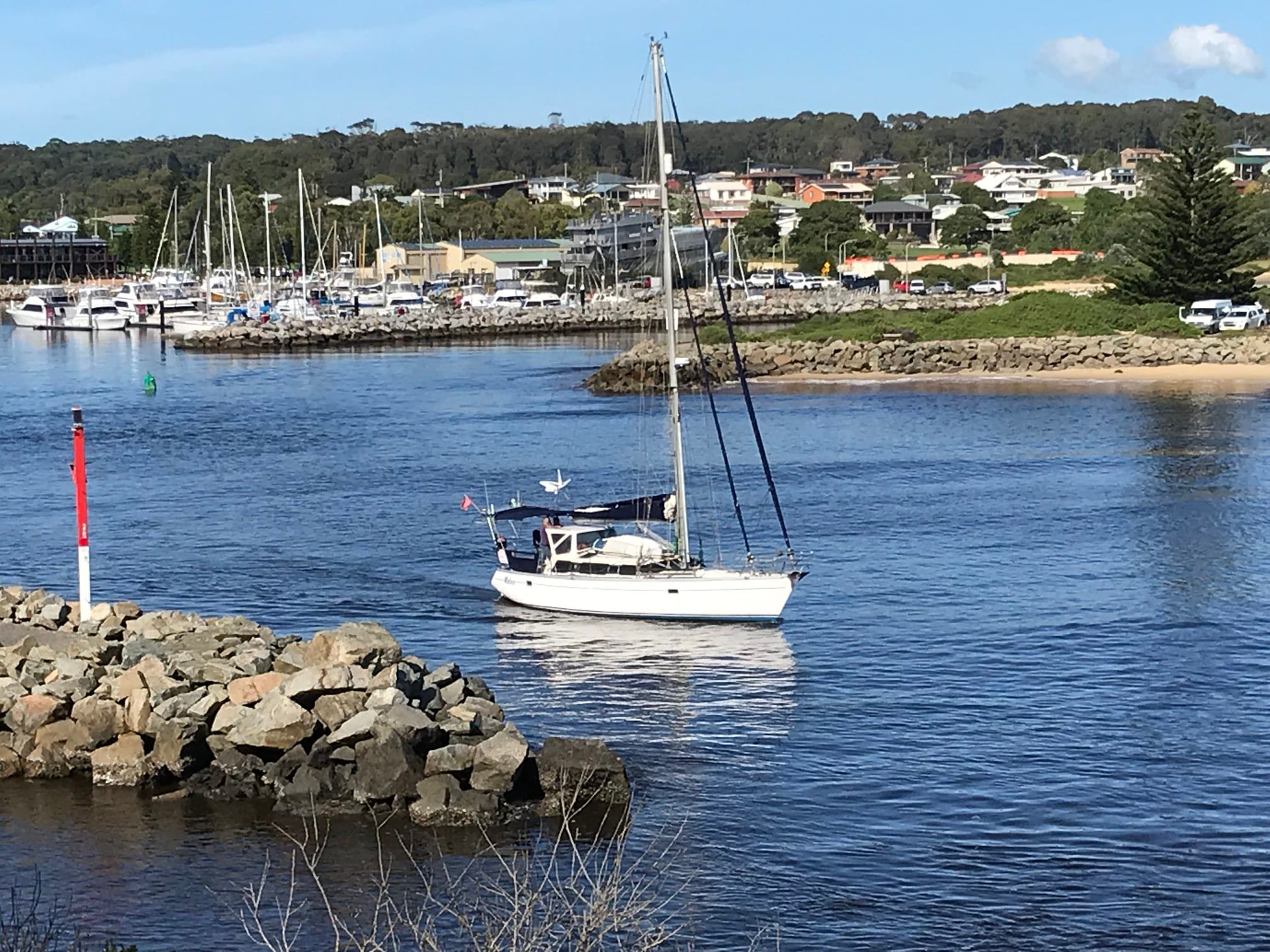
Duncan H drove us down to Bermagui along with his family, and we cast off the following day as we set off in a relatively calm sea with the wind aft of the beam. The sails filled abeam of Eden and we rolled in the genoa and switched on the iron genoa as we crossed the shipping lanes just as the sun set.

At noon on the second day we were at the halfway waypoint as the noise of the engine purred in the background. This continued for the full day and night on flat seas and little wind, but at midnight, just as I went off watch and fell asleep, the thunder clouds and lightning came barrelling in from the west. Luckily they passed to our stern (north) and we were spared the rain and lightning. I was informed, at change of watch, that the light show was dramatic.

At dawn of the third day we were following the drop-off of the continental shelf and were abeam of Eddystone Light. A southerly change was forecast at noon and almost on time it arrived from the south at 18 knots. The next three hours were lumpy as we tried to get away from the upwelling of the southerly flowing current and the northerly a direction wind. We finally broke free and set sail for the area of Wineglass Bay. I do not like this location, and two yachts, also on the crossing, chose the bay to anchor and regretted their decision for three days as they rode out adverse winds and rolly conditions.

We turned towards Prosser Bay at midnight and dropped the anchor in the NW corner seconds after 3:00, as Duncan—our meticulous navigator—had stated hours earlier. That gave me great confidence he would guide us through the Denison Canal during the neap tides and reducing water under the keel.

The next two days were spent at anchor in Prosser Bay as we rode out a westerly gale which saw the wind instruments touch more than 40 knots at times. The Lone Star anchor held in deep sand and flat water.

Malua has passed through more than a hundred canal locks in her time, some as high as seven storeys above the deck level and on occasions less than inches below the keel, but this canal has history with Malua and changing sandbanks and shallow water, so Duncan's navigating and planning almost down to the second and his expert helmsmanship got us through the tidal narrows and at the entrance to the canal exactly on time. Now we were dependent on the lockkeeper to keep his part of the planning and let us through at the appointed booked time. As the minutes ticked by and the tide started to drop, we waited as one after another vessel came through towards us.

Finally, with four vessels waiting, we were instructed to enter the shallowest part of our passage. There was, as planned, less than 200 cm under the keel. Not a big margin of error. We passed without a hitch through the narrow swing bridge concrete canal (this time with no lock keeper with fishing net to receive a gift of thanks) and out into the sea.

The next two days were spent shuffling away from one lee shore to the calm of the opposite shore, waiting for the right wind to blow us up the Derwent towards Hobart. We pulled the anchor up at 6:00 on our way to the Royal Yacht Club of Tasmania, expecting after a letter of introduction from the Canberra Yacht Club to have the red carpet rolled out and a band waiting on the dock. We went astern into a large dock completely unnoticed alongside a number of Sydney to Hobart racing yachts and other large vessels.

So ended a very uneventful passage across Bass Strait with no gear breaking, the freezer slightly emptier and the help of a very accomplished navigator who I hope took away some tricks and tips from sailing on Malua. Thank you for the wonderful company, Duncan.


04 January, 2026

Preparations for the Summer Cruise

 Winter is now over and the Kayak project is complete with the launching in Canberra and test paddle in Malua Bay.  So now preparing for the sail of the summer around Tasmania.

Just like the last dream trip, a lot of work had gone into Eye Candy prior to our leaving to cross Bass Strait, but in that case Andrew had done the work.  It was now my turn to prepare Malua for the summer.

I asked the local Jubb slip if he could haul Malua out and antifoul it.  As expected he said the first week in April the following year, so I said that would suit me just fine—so let's set the day.  I called his bluff, at which point he got annoyed and told me to leave his boat yard, just as he had done on two previous occasions.  I always give the locals a chance, but not again.

As you would have expected, I had my Plan A, so the following day Jim G and I set off for Wollongong harbour.  The wind came up from the south as we headed off for Jervis Bay and our first overnight stop.  The next day we were off around Point Perpendicular and up the coast, by which time the wind had risen to well over 25 knots from the west.  A few reefs in the sail and some flat sea and we were steaming along towards Wollongong.  We arrived and pulled up onto the courtesy mooring and went ashore to the slip.  We found the Pasadena Star, a steel fishing boat on the large cradle with a number of large square holes cut in the hull and the welder Henry trying to cut and close the rust that almost sunk the vessel.

This delayed us a few days.  They finally launched it on a Friday, so I could only go up on the slip on Saturday.  No worries—Jim took the bus back to Bermagui and I went to visit Nicola at Fairy Meadow.  I returned to Malua every night as I was moored alongside a fishing boat belonging to a cousin of Tony and Charlie L from Ulladulla—small world.

Work started on Malua after it had been very well pressure washed soon after coming out of the water on Saturday.  Monday was a quick touch up of some undercoat and good clean of the waterline, and they were off spraying 80 to 20 mix of blue and black Seavictor 50 Jotun antifoul onto Malua.

The Swedish shipwright did a very good job while the other did all the masking of the through hulls, waterline and cleaning the prop.  That was finished by noon and then he started on the Propspeed for the propeller.  The clearcoat went on and next the zinc anode, and we were ready to go back in the water but had to wait eight hours for the Propspeed and the tide.

Tuesday dawned and we were ready to go but had to wait for the high tide, which was about noon.

The two shipwrights and I got on Malua after clearing away the sand from the slip rails, and the large cradle started to run down the rails into the water. Malua is rather light for the large cradle, so it did not run all the way to the end stops and we had to wait for the tide to rise before Malua floated off back into its natural environment.  I dropped the fellows at the wharf and headed out into the sea for a trip south.  I pulled into Jervis Bay for the night and out the following day to get into Batemans Bay before a very strong gale force wind came off the land about 1:00 that day.

The wild windy Wednesday hit me just as I was about to enter Batemans Bay with a force of 47 knots. The spray was coming off the sea in sheets.  It was the most violent wind I have experienced in Australia.  I had dropped all the sails as I saw it coming and tried to motor around Yellow Rock up into the Clyde River mouth of Batemans Bay.  Malua would not make any headway at all.  I had to keep the bow directly into the wind or else I would lose direction and be blown off course.

I tried sheltering behind the Tollgate Islands but that did not work, so I moved to Black Rock, but again the wind was too strong to motor into it.  I eventually turned and headed for Bermagui with the wind on the beam and a good run down the coast.

At Montague the wind dropped, but the swell and confused sea made the last 12 nm into Bermagui a very violent and uncomfortable ride home. I entered the harbour in the dark but with little wind and came alongside to be welcomed by Macca.  What a trip.

I now had almost a month prior to Christmas to polish the topsides, add a few extras and to get the inside of Malua ready for a three-month long cruise to Tasmania.

04 March, 2025

Was that a dream or even maybe a short video I watched? BUT no, the trip from Eden to Tasmania across Bass Strait was real on board Eye Candy.

It was four days in duration with a good night's sleep as an interval to travel the 360 nm from Eden in NSW to Orford, Prosser Bay in Tasmania. There were just two people on board a 39 ft Bavaria production yacht.

You and I may well ask: why did it go so well? What factors came into play for us to cross the infamous Bass Strait with such apparent ease? How come it went so well? There are a number of factors, so stay with me.

The key factor is timing. Yes, not sailing to a schedule like the Sydney to Hobart Race. Andrew and I had been studying the weather patterns for more than a month. Originally for him and Claire to cross Bass Strait. We concluded that at the beginning of February there was not a good window for him to cross, so he sailed from Eden to Bermagui and put Eye Candy in the marina and returned home. He returned to the yacht and sailed with a northerly to Eden but had to wait ten days before a short window opened. Claire, who has sailed extensively in the Med, crossed the Atlantic, cruised the Caribbean and then the East coast of the USA including going through a Cyclone. Eye Candy passed through the Panama canal and spent a full year in the Pacific before a further year in the islands of New Caledonia, Fiji and Vanuatu before arriving in Australia. Well, as one gets older, your outlook and tolerance for cold and wet nights decreases, so she decided to take the big bird to Tassie.

Andrew called on me to join him as we had been watching the weather, and I knew the risks and how wide the window actually was. We talked through three options for the passage. Plan A, a straight line course from Eden to Triabunna. Plan B was developed the day before we left, which included a stop in the Furneaux Group to hide from a Southerly front that swept up from the south, but that strategy depended on the tide between the islands near Cape Barren Island. Lastly, we had Plan C, which also depended on our average speed crossing the Strait (we originally estimated our speed to be 6 knots). If we achieved that or better, we could hide from the southerly change around Eddystone light or Binalong Bay, north of St Helens. So we had a few plans we could fall back on as we progressed south.

The second factor is boat preparation. This is more than sitting at your desk with a to-do list and ticking off the various essential items in the marina. It is real live sailing on the vessel in all conditions. Now Malua has spent some time in the marina, so I can't at the moment say all systems are working; however, Eye Candy has been sailing for months on end since arriving in Australia. So I stepped aboard knowing that the autopilot worked, the rudder had been maintained, and all the normal systems worked. I also knew, just like I do on Malua, the sailing – yes, the sails, halyards, and sheets were in the right places, had marks on them where they should sit when you hoisted the spinnaker pole or other sail. And furthermore, Andrew could do all of these operations by himself. All I had to do was turn the handle and the main went up or pull in the brace on the pole. Now, there are a number of things on Eye Candy I would not do; for example, I don't like anything to be on the foredeck, especially when I raise the spinnaker pole either for the big bag, reacher, or more frequently attached to the genoa. Andrew likes it because he can sit on it to raise and take down the pole.

As I found out during and after the trip, everything worked, nothing broke, and more importantly, we did not have to rush to adjust or untangle a sheet or line (One issue with the new sail, but rather my lack of knowledge rather than an issue). So, as I always say, practice, practice, and men and boat rot while in harbour, so get out and sail.

A further factor which I rate high on my list is Food and Sleep. Let's take the latter first. It is not the ability to stay awake during a passage, although while on watch, that is essential, but the ability to fall asleep instantly when you come off watch. Like the above, I say practice. Yes, but I sleep every night... Yes, you do, but I bet you have a routine. Dinner, some TV, maybe a shower, and then into bed with a book for a few minutes, then the light goes out and you fall asleep. It is that routine that lets you sleep. Well, try going to sleep on a full stomach or maybe with the chainsaw running just outside your window. So practice, practice, and note which suits you best. Then on the boat, do the same. I have a routine which suits me, so after three deep breaths, I am asleep.

Now food. Remember, falling asleep, not staying awake, is the mantra. So no coffee or tannin-based tea on the passage. I drink instant miso soup and Rooibos tea. It suits me well. Food is the next essential. Three or, as I have, four meals in 24 hours. Sunrise and sunset and noon and midnight. Any style of food is suitable, but not chilly, but something which is eaten in a soup bowl with a spoon. I prepare stews and boil rice or small potatoes and add a veg for the last few minutes.

Claire had prepared four meals in true five-star chef style, and all I had to do was open the vacuum bag and reheat in a wok. A delight and a variety of tastes I had not previously experienced. The photos is our arrival meal I prepared with chip additions from the local take-away.

Lastly, no chocolate or sugar-based muesli bars. You get a sugar hit and a high and come down with a bang. Either during your watch or on the high when you are trying to go to sleep.

The last factor is the on-passage knowledge. Yes, knowing where you are, when you reach a waypoint, and where the other hard objects are relative to your progress. Wind and waves are included. For the latter, to put in a reef before the 30-knot front hits. In my case, don't catnap when you are sailing towards the shore. The list goes on, but it does not depend on your phone or tablet for navigation. I am not talking of pilotage into a bay but open ocean navigation. I only use these devices as a backup and for pilotage. A good chart plotter or, in my case, two small Raspberry Pi computers running independently on 12-volt power, each with their own GPS, are the primary systems. One with an AIS and the other connected into the chartplotter backbone for wind and depth. My Vesper Marine AIS is also standalone and flashes and screams when the CPA is less than 2 miles.

Eye Candy has the standard Raymarine system, which is adequate, but they drain the battery, and the screen is cluttered, and even I find it difficult understanding the logic of the menu system. The MOB is hidden in a menu.

The final word on this dream is always a bit of luck. As a famous sportsman said, the more you practice, the luckier you get. I believe in that, and with Andrew's extensive sailing experience, not only cruising but in big fast boats, and mine added, the odds of a dream passage were high, and we did it.

Thanks, Andrew and Claire, for the experience.

PS The last factor which is a given, know the boat, its systems and how it handles the conditions and when to reef and take over steering.  Also how to fix the small things like a loose fan belt or wire.  

Arrival dinner I cooked with chips from local take away


24 February, 2025

Eye Candy in Sardinia 2010

A new adventure starts tomorrow when I board Eye Candy a Bavaria 40 ft vessel I have sailed with since meeting Andrew and Clare in the Mediterranean in about 2007.  I am off to Tasmania from Eden for a quick passage to get their boat in that area for the winter.  Not in the water but on the hard.

Clare, is Andrew’s wife and sailing partner for all their passages from the east of the Med across the Atlantic, up the east coast of the USA then through the Panama Canal and across the Pacific.  Under normal circumstances Clare would stand watch, prepare meals and do all the things that Andrew does not do but on this occasion because the forecast does not look particularly good they asked me if I would like to come aboard. She will take the big bird to Hobart.

Now, I very rarely accept invitations to crew on a vessel but of all the people I have choose, Andrew on Eye Candy is the one at the top of the list.  I am sure the vessel is in tip-top condition, the systems work and the planning is detailed and in depth.  Furthermore, of the occasions I have dined on board Clare’s food rates along with the best five star chefs anywhere in France.  She assures me that she has cooked, vacuum bagged and frozen everything needed for the passage and all I have to do is follow her instructions next to the stove.

The bus from Canberra leaves at 4:00 pm and I arrive in Eden at about 9:00 pm to go aboard for the first safety briefing.  We expect to up anchor the following morning.  At this stage after many conversations we have come up with a float plan to take the Northerly south to the Finders group of islands, stop and hide from a strong southerly front to pass (the same type that caught me by surprise the last time I crossed the Bass Strait).  We will the take off the next day to sail in the dark south along the east Tassie coast to arrive in Coles Bay before sunset on the third day and the onset of a strong south west wind.

There are a lot of variables and uncertainties so we will have to adjust as we go along.  I have complete confidence in Eye Candy but it will be a learning experience to sail a production yacht as compared to my trusty Adams Bluewater cruising yacht.

26 January, 2025

A project for the winter months

In 2024 Denny and I sailed Malua- our Adams 42ft yacht north away from the cold of the South Coast to the tropical warmth of Queensland. As is usual I left Bermagui for points north - this time with Jim G as crew and we managed to sail quite quickly on a southerly right north to the Gold Coast. Jim then flew south and I battled my way north against the persistent northerly winds. That is a story in itself. Denny arrived via the big bird into Mackay where I met her and the next day we were off to the island and to the famous Great Barrier Reef and the Whitsundays. The wind persisted to blow from the north but it also rained and blew and rained and blew. Denny flew home having not spent a single day in the water snorkeling in the "crystal clear waters of the reef".
My return journey is well documented in the web site here and features as a chapter of the book Storm at Sea in Malua.
Malua will not be returning to the Whitsundays this winter. So what to do? Well I have a large timber stack of the planks I did not use in the construction of Malua so why not just build another boat. A bigger boat? No a smaller boat and a kayak. I now have a winter project of building a strip planked kayak out of myrtle. The design is a MICRO BOOTLEGGERER SOLO The design and history was inspired by a 1924 mahogany speedboat and designed by Nick Schade of Guillemot Kayaks. It combines the classic lines of a double paddle canoe with the functionality of a modern kayak. I purchased the plans and had them printed off at full size. Then came the task of finding space to create this kayak.

The kayak blog is here www.maluakayak.blogspot.com  Follow the progress as I build the kayak

08 January, 2024

Two Hulls not one

 Tomorrow I climb aboard the big bird to fly to fly to Cebu in the Philippines to assist a very good friend bring a Lagoon 420 catamaran - yes two hulls, to Australia.

Jim purchased this vessel his last was a trimaran (will the next have only one hull) in the Philippines at a very reasonable price.  The sales material looked good so he and his partner flew to Cebu to inspect the vessel.  A survey indicated it would make it to Australia - with a little work so Jim purchased it thinking he would sail it to Australian within the month.  He invited me to accompany him but I put my foot down and said I wanted to have our usual family Christmas at Malua Bay so he delayed the voyage until January 2024.

Here is what it looks like.


I will post a blog at www.seadragon2.blogspot.com Blog so you can follow our passage.

Our route is Route

19 November, 2023

The final sprint home


This sprint to the finish I have sailed more than 25 times so I knew my way home but did I know the weather and what was waiting on the route?

The weather forecast showed that a good NE wind would be blowing on the Saturday and reach 25 to 30 knots during the nights but it was with me and the current was also in my favour.  The speed to beat was 9.5 over the ground set off Port Stephens in the last leg and I knew I would easily do this on this leg.

Now this is 160 nm at about 6 knots that would take a day and a half at most.  I moved from the Fish Market and sailed over to Middle Harbour and picked up a mooring right along the shoreline.  The local yacht club was having a sponsors race so it was filled with yachts and very smart crew not sitting on the rail but holding a glass of the local bubble stuff or on some real champagne.

I had prepared a few nights meals and tucked into one as the sun set.  Again I set the alarm for before dawn and when it went off I was off and running with one reef in the main and a poled out genoa.

I soon cleared the heads and set a course past Port Botany and directly to the Sir John Banks banks to the north of Jervis Bay.  Now my normal course going north is inside the banks and under normal conditions I would go 5 nm out to sea from the banks to get round the very rough conditions associated with the great East Australian current hitting the shallow banks which come up from 120 m to less than 12 meters.  You can imaging the turbulence as this stream of water flowing from 2 to 4 knots hits the shallow water of rocks.

I have passed this point many times before and in many wind conditions but this time was an a different experience.  The wind had increased and the waves while not ocean swells size were quite big but nothing Malua’s autopilot could not handle but the confused seas were something else to behold.  They seem to come from every direction.  Breaking over the bow, stern and even jumping on board from the port side.  A tug steaming north call on the radio a similar company tug seaming south to have a chat then asked why he was so close to the banks and he should turn more out to sea.  I was tracking him on the AIS all the way down the coast and immediately after the communication he turned and headed out to sea for calmer waters.  I staid my course.

I was committed so I continued knowing Malua was on a roll and I had beaten the top speed record when I reached 10.8 knots SOG.  Decision again.  Should I continue and reach Bermagui during the night because now at 5:30pm I would arrive at dawn or even predawn and I would have to wait till the sun was up to enter the Bermi river mouth with a raging NE wind and swell.  I, as always, took the prudent decision and jibes at the entrance to Jervis Bay in the lee of Point Perpendicular and steamed into 25 knots of wind to the northern shore of the bay at Long Beach to take a break.  I arrived after dark to find a catamaran with all lights on and a much smaller sailing vessel anchored near the shore.  I have thrown the pick in this area before so I knew that one had to drag the anchor in because it often got fouled on sea grass.  With the strong wind and a depth of 10 meter I let out the normal 40 meter and started to pull back on the anchor but it kept coming.  So up anchor and I immediately noticed the SQR had speared a cockle shell right at the tip so it would not hold.  Up to the bow with the hammer to release the shell and start again.  Down went the chain and I pulled back.  The SQR and 50 m of chain held and I set the anchor alarm and proceeded to get Malua ready for the next leg of the journey.

Alarm went off at dawn – no point in early start as I only had about 80 nm to run to Bermagui.  I checked the latest weather forecast and BOM indicated that the wind would reach 35 knots along the Batemans and Eden coast.  The temptation was to wait and see what the next day would bring.  On this occasion prudence did not make a planning decision but when I set sail I did put two reefs in the main and furled the genoa on a pole well before I exited the calm but windy Jervis Bay.

I flew out of the Bay and headed for a straight line for Montague knowing I would be about 10 nm off shore and well in the southern flowing current and the ocean swells that accompanied two days of strong wind.  Little did I know what the ocean had in store for me off Batemans Bay and further south.

I had kept the boom on the starboard side as the wind was from the NE but as I sailed further south the distance from the coast got more and more as I tried to not have to jibe in the current conditions.  Malua was handling the swell and wind well although it was obvious that I had too much sail up and I was about to do a jibe.  I prepared to jibe by undoing the preventer and moving it to the port side then started to pull the main in via the electric sheet winch.  At the critical point I turned the auto pilot to turn to starboard and the wind got behind the sail and it came over – not with the bang I expected but with a genital flop.  Out went the sheet, correct the course and connect the preventer and we were off and running again but this time the waves had built to 4 or 5 meters .  I know it is difficult to estimate the height of the sea as one faces down a water slope with the horizon almost completely covered in spray but on this occasion I knew the sea was big as a crest rolled down the hill and right into Malua’s cockpit.  No water down below (washboards in) but it wet my granny seat!

The autopilot alarm went off as I sat in the captain chair and watched the dials and wind speed indicator.  On the second occasion even with two reefs in the main and no sail for of the mast I knew we were over-canvased.  What to do with only 40 nm to go to Bermagui.  So I stepped into the cockpit and took control of Malua as we surfed down the face of the waves and swell.  I have not done this oftem and had not realised the effort it takes to keep a long keeled boat on trach with too much sail up.  Malua wanted to round up into the wind as we reached the botton of the swell so one has to anticipate what will happen.  With all my effort on the large wheel I lent on the spokes and kept the bow on course and down the waves.  This continues for a while and then the wind started to ease and the autopilot took over.  We settled down for the final straight to the finish but there was more to come.

What to do was the decision to be made.  Continue to head for Bermagui and a potentially dangerous bar entrance with seas breaking over the entrance or slow down and wait for either the wind to drop or sail on to Eden.  Now I am a great supporter of technology but my confidence in NSW Maritime is very very low so when I fired up the computer and switched to the NSW Maritime Bar camera for Bermagui and saw a small swell with about 17 knots of wind I thought they must be playing yesterdays video.  I stuck my head outside and yes the wind indicator showed 35 knots of wind and the sea and swell big SO what was going on.  I again checked the Windy app at a more detailed resolution and saw that there was a patch of calm wind along the coast which I had never seen before.  What is going on?

I set a course close to Montague so that I could drop the main in the lee of the island but as I approached the island the wind started to drop from 35 knots to 20 knots and then in the 15 knot range.  The Maritime bar camera could be right.  I phoned a friend.  “Can you tell me what the Bermagui bar is like?”  Sorry I am 20 km away.  My second lifeline did not answer so I thought maybe windy app was right. there is a pressure difference along the coast as a system moves north.  Take a chance and go for it.

About one mile off the entrance I turned up wind into 12 knots of wind and a moderate sea and swell and took the main down, furled the genoa and staysail and put in the washboards again to cross the bar.  I have a course I use which takes a curve towards the beach then moves west of the leads and come in as close to the western break-wall as I feel safe.  I adjust my speed to try to time a lull in the swell.  I saw my chance and increased the engine revs and held the wheel with both hands as I aimed for my entry course.  As I passed the headland I looked up and saw a few people standing watching me enter.  Peter S holding his camera.  The below photos is thanks to Peter.  One of the most dramatic shots of Malua that has been taken.

I entered the harbour, lowered the fenders and made sure all the prepared docking lines where ready and headed for my berth.  A group of friends: Jim, Keith and Peter were ready to take my lines as Malua nosed into her berth.  We were home.  The whole trip had been a sailing success with nothing on the boat breaking.  A great result.  Malua had lived up to the reputation of the great thoroughbred horse from Tasmania.


08 November, 2023

Malua the Thoroughbred


Malua, as you may well know, is a famous Australian horse born in Tasmania. The horse Malua was the most versatile Australian thoroughbred racehorse in history.  Malua won over distances ranging from 5+1⁄2 furlongs to 3+1⁄4 miles (1,100 – 5,200 metres).  The term "Malua's track" was coined to name that portion of the Flemington Racecourse where he showed excellence and speed.

In 1884 he won the Melbourne cup.  Carrying 9 st 9 lb (61 kg; 135 lb)  In 1888 he was switched to jumping, not so unusual in those days and he won the VRC Grand National Hurdle.  He then had a very successful stud career.

Malua was inducted into the Australian Racing Hall of Fame in 2003.  In the suburb of Ormond in Melbourne, there is a street named after the great horse (Malua Street).  A memorial to Malua was erected and opened in October 2009 in the Deloraine Museum, in the town where he was born.

With that pedigree front of mind, I set off from Bundaberg on my way home to Bermagui.  To say Malua had the bit between it's teeth would be an understatement as we flew south with the wind behind us.

I left Bundaberg at about 4:30 am to try to make the tide at narrows in the north of great Sandy Strait to the south of Fraser Island.  Eye Candy also left Bundaberg early and was in hot pursuit but fail to catch me as I entered the shallows at Sheridan Flats just one hour after the top of the tide.

I had my track going north as a guide and tried to follow that as best as I could but turned to port when I should have turned to starboard and nearly went aground.  When through the shallow it was on with a race towards the entrance at the wide bay bar.  I had to stop for the night to wait for the next mornings tide.  The following morning the high tide was at 1300 with the tide rising or flowing into the great sandy straits.  Not the best scenario for a quick exit.

I arrived at the sea entrance of the wide bay bar near Tin Can Bay at about noon and immediately hit the incoming stream full on.  My speed dropped to 2.5 knots and Malua battled against the wind and short chop.  It was a battle to make headway to the virtual way-points some miles out to sea but still behind the bar.  The wind at about 20 knots at this time was almost on the nose, the swell small but short so Malua took every hurdle in her stride as we made our way towards the finishing line of the bar.

On reaching the bar we turned to starboard and up came the main as we started to lengthen the stride for the next finish at the Gold Coast Seaway entrance. That was about 135 nm or 24 hours at 6 knots.

The sun set but no moon rose as we continued south.  The wind started to head south so by 2:00 am it was a full on beat into very confused sea and many large vessels wanting to come inside me (shoreside) as I raced south.  About 3 hour before dawn the wind and rain started – not a light rain but a full-on down pour which reduced my visibility to a few miles.

I was now abeam of Brisbane with large ships entering and exiting the seaway and five trawlers steaming north.  With all their lights on it is easy to sea them but one can not make out their steaming lights (Red and Green) so you don't know in which direction they are travelling.  They do not have any AIS signal and don't listen on VHF Channel 16 so there is no response to calling them.  It is just get out of their way.

I was keeping a good watch but out of no where a well lit trawler appears not 100 m from my port bow.  I turned the wheel and held my breath expecting to catch the keel on the net towed behind but thankfully Malua continued to race south averting that fence and off to the finish line.  Here the tide was in my favour but the sea was very confused as it crossed the shallows of the Seaway entrance.  I made it through and turned to port towards the Seaworld anchorage.  Bums Bay I understand, but I dropped the anchor attached to a nice shiny galvanised chain in sand with about 4 m of depth under the keel.

After stowing the sails in the cover and clearing up it was time for a shower and a well deserved beer.  Food then off to bed….

No need to go ashore and re-provision, I just had to wait for the right from the north to sail south.  This leg would be the longest but easy if the wind was  from behind and the current running south.

I did not have to wait long for the right weather forecast for this leg to sail to the next resting stage which was 400 nm away – that is almost 3 days at 6 knots.

26 October, 2023

Winter is here and I sailed north

 When the temperature in Canberra get to -6 C Yes minus six then it is time to get on Malua and sail north to warmer waters.

That is exactly what I did but the wind Gods had not got the change of seasons right so the wind continued to blow from the north. The direction I wanted to go.  This delayed the trip by some weeks while I spent a lot of time looking at the weather forecast.  On the days  that I was able to sail north I made the best of the wind and made miles north.

Denny arrived at Mackay via the big bird and we set off for points north

Our first stop was at Brampton Island which we had flow into in 1972 with 8 other Armidale friends during our flying circuit of Australia.  We walked on the airstrip and visited the now closed resort.  The resort was hit by the tropical cyclone a few years ago and the sand and water came right up into the bedrooms.  The furniture has been removed but the sand still remains.  The current owners can not get planning permission to rebuild because of all the regulations.

We left Brampton and day sailed along the island chain towards Airlie Beach because it was obvious that the RIB I had so carefully restored was coming apart and filling with water. Furthermore the two outboard engines - one two stoke the other four stoke objected at being associated with the sinking RIB and refused to start or restart when we were on the beach.  They came very close to joining the previous outboards in Dave Jones Locker but saved themselves for the time being.

At Airlie Beach I purchased a new 4 stroke 8HP Yamaha outboard and had it delivered to the wharf but I could not collect it because of the RIB was not totally coming apart.  Next was the purchase of a RIB.  Now I have to admit I made a significant mistake in my choice of supplier. Marine.co  The MD assured me it would be in Airlie Beach within in 7 days.  Three weeks later after a great effort tracking it down It was delivered to my nominated address BUT the sender had not put my name on the unit so I had to go to great lengths trying to convince the owner of the yard that it was for me.  The suppler had by now taken off with my funds and washed his hand so was not answering his phone.

OK Have outboard and inflatable RIB so we can now visit the islands and enjoy the "Best cruising grounds in the world"  Oh no they are not.  Crowded with charter catamarans with people who think that it is a large RV and no seamanship knowledge.  The moorings are in the best places so a normal vessel has to anchor outside in the deep water.

The wind blew and it rained for almost 3 weeks as we tried to put on a brave face and enjoy the sunny tropical paradise of Queensland.  In the end Denny decided rightly so she would return to the warmth of our Canberra house and flew out on the big bird (Jetstar) after a significant delay back to Canberra.

I the set off for Bundaberg to haul Malua and get the 100 m of Australian chain galvinized. The haul-out went well with a 3 coats of anti-foul and a top side polish I was back in the water in 3 days but no chain.  The local Chandler had stuffed up the delivery of the chain and it would only be delivered the next week so I was left in the water no marina berth and no chain to attach my anchor to so I could anchor in the river.

I took my 28mm nylon rode  and attached it to my very best 35kg Brunzel anchor.  It lasted the first night but then at dawn on the second the wind had come up to 20 knots the tide was running in and the anchor alarm went off.  I was drifting up river with the current and the anchor was dragging through the mud.  At some point the anchor got round the keel and the full force of the water was side on to Malua as the rode strained against the sharp edge of the keel.  I did not start the engine expecting the nylon rode to get round the prop so I sat and waited for the tide to turn.  I did not wait long and bang the nylon snapped and I drifted towards the river bank.  I haul in the the short line and motor up river to potentially the calm of the river at Bundaberg city.

I have three other anchors on board but no chain so what was I going to do?  The Danforth was the best option for the mud but after a few minute it too started to drag.  I picked up someones mooring and set the Danforth over the stern with some dive weights to keep the rode along the bottom.  This held while for the next few days I worked out how to get my chain from the factory to the boat.

I selected a wharf and asked the owner if I could come alongside at high tide to load the chain which he kindly agreed.  Now to get the chain from the factory.  As we say in Australia the chandelier came good and delivered the chain to the wharf.  I loaded the chain and attached my big SQR and Malua was again fit for the sea.


Now the trip home.  That will have to wait for another day.

10 June, 2023

Preparations

Somehow COVID changed the settings on adventure and journeys because when I thought about sailing north to Queensland during the winter in New South Wales I found the Malua needed a few extra things and some testing to make sure that she was ship shape like Bristol.

The first obvious one was the wind indicator.  The years spinning at the top of the mast in rain, shine and in some cases snow, the unit was giving intermittent readings.  It would work for weeks on end then stop.  So I had to reset the relay and hope it would come up and give me the vital piece of information - the wind strength.  I had been up and down the mast so many times I lost count so in the end I took it down, collected the wind digital display and installed it on my workbench at home along with a 12 volt fan to turn the cups.  The instrument after a good overhaul work perfectly on the bench in Canberra.  OK so it it did not work when installed at the mast head then it must be the cable from the top of the mast to the navigation station.  I tested that and found that all wires were good BUT when I connected the wind instrument it did not register even a breath of wind.

Simrad had long discontinued the top of the mast wind indicator and moved to the more modern NMEA 2000 so that avenue was closed off – even the second hand market gave no results.  The search was on for a unit which would interface to my instruments and the chartplotter without a full time conversation unit.  I found one at Digital Yachts which according to the specifications met all my need.  I looked to source the unit in Australia and found CJ Smith, a chandler in Melbourne according to their web site had one in stock and ready to ship the next day to arrive If I paid a little extra within 5 days.  Out with the cc and purchased the unit.  Wait, wait, then phone calls.  “Where is my unit?”  I will get back to you…. Sorry it is not in stock, we have your money but will not refund it but it will be shipped to you next week.  Wait, wait.  “Where is my unit?”  Sorry there has been a mix up and we are expecting it in a few weeks.  “What? Cancel the order and refund my money.”  Sorry we cant do that at this stage because we have ordered it via the agent here in Australia from the UK.  “Why did your website say it was in stock?”  That is only and indicative position…..

I will not bore you with the details because we have all gone through this before where Australian chandlers say they have the goods but in fact they are just an indent agent ordering from the over seas supplier.  If you had cone to the original manufacturer you may have got the unit within a week.  So how long did CJ Smith take to deliver the wind instrument? One month? Two months? No there is more... They took more than three months to deliver the unit.

Thankfully when the unit arrived I tried it on the workbench and it worked and then off to Malua to install it at the mast head.  A local live-aboard helped push the electric winch to pull me to the top of the mast and scoffed all my chocolate biscuits as he waited for me to come down.  Thanks mate “You own me big time” Oh yes why? My time.  But that is another story.

The unit fitted as per specifications and worked first time I connected it to the network, display instruments and to my Raspberry Pi and was able to display wind reading on all units.  I was happy and ready to set sail.

You may ask why it took me so long to prepare to sail to Queensland that is just one example. There are others but finally Malua was ready and a weather window opened along with a full moon and Malua set off north.  I had Jim G on board for the three day trip to the Gold Coast.

27 March, 2022

Cruising the Lakes


Malua has travelled in may waterways around the world from the high seas of the southern ocean to the canals of France and also the brown waters of the inter-coastal waterways (ICW) of the east coast of the USA.  Maybe the most amazing waterway was the Hudson River flowing down the shores of Manhattan where we stayed opposite 48 St for almost a month.  Now this last location was right in the bustle and noise of down town New York so to set off up the placid water ways of the Victorian Gippsland Lakes was what Denny and I needed.


The passage westwards up the entrance area is quite easy and very well buoyed.  We entered the Bancroft Bay which opens up to a wide lake and headed for the northern shore and Chinaman's Creek.  Here we stayed the night and the following day exploring the creek and the surrounding bush land - a bit different to downtown Manhattan or even Lyon. 


Next day up the anchor which was covered in mud and off to the local pub at Metung for a drink and some food.  This is a great place to walk along the shore and look into the many holiday homes overlooking the water.

Where to next?  Well you dont have to look for a weather window or even consider the swell or wind.  It is just cast off the lines and off one goes to the next destination which in our case was Paynesville.


We pulled alongside and tied up to a very accessible dock and walked the water front before preparing one of the gourmet meals Malua is famous for.  No French truffles and Brest chicken at the local market here but still good food.

I unpacked my folding bicycle and rode to the local marina and boatyard.  Only to find it was up a creek and not easy to access or to find a local motel so Lakes Entrance was a good choice.

After a long walk on Raymonds Island we returned to Malua and a good sleep.  Next day it was off to the upper reaches of the lakes into Duck Bay and the bush surrounds.  Unfortunately it rained and rained for a few days so we were constrained from doing any long walks but did see a few tracks.  All well signposted and easy to follow - where has the adventure gone in the modern world?


It was now time to head back to Paynesville and towards Lakes Entrance.  No planning required just up anchor or in this case let go the mooring line and point the bow along the track to the next waypoint and there you go - we are on passage.

We stopped at Paynesville for a few provisions and at Metung for an evening G&T then head back to Lakes Entrance.  The water outflow was with us and we made quick time back to our spot at Lakes Entrance waterfront along with the fishing fleet.

Thankfully our VW Golf was still in the parking spot we had left it next to a few fisherman's vehicles who had also gone to sea - quite a relief.

A magical moment on Malua


25 March, 2022

On the hard - Anti-fouling


Bullocks Island government hardstand is a very well run facility with safety and security featuring very high.  One has to do an online safety course before they will take you out of the water with a well managed travel lift.  It was done very well but they sure know how to charge for extras you did not ask for.

Finally get Malua on the ground with scaffolding all around. and ready to start the work.

An aside.  One of the reasons I had chosen this location was that I had been negotiating with a potential purchaser of Malua who lived near Melbourne and we had agreed that as a condition of purchase he would organise an out of water survey to occur after the anti-fouling had been applied - about Wednesday.

He arrived on Friday evening just as I had docked Malua at the new location and asked to come aboard.  After some hesitation I said yes and he came down below.  From the instant he stepped aboard I knew he was not interested in the purchase because he took little interest in the vessel.  I answered his questions and then asked him to leave but he again insisted to see the vessel on the hard on Monday - what could I say?  On Monday he arrived and looked at the bottom and prop.  I asked when would the surveyor be arriving and he came out with the statement: I have not arranged one!  Well that left me up in the air with very little time to organise one at this location in two day.  My full persuasive power where brought in to bear as I asked a local surveyor to do the job.  Thankfully he arrived on the appointed time and undertook a very comprehensive and detailed survey.  Malua passed with flying colours.

Now on with the work.  I have completed a wash, sand and two coats of anti-fouling in less than 8 hours along the east coast of America when cruising in that area.  That was hard work and good organisation but it is possible with a night to dry before splash down the next morning.

Our labour laws only let the locals work from 7:00 am to 3:50 pm four days a week - Fridays is early knock off.  Here they want to lock up so you cant stay on board or work after hours.  Most days I had to rush to pack up before they close and find a motel to stay the night in - just a short walk away.

No one afternoon I forgot a vital item on board as I hurried to close up Malua for the night and only realised that I had left it behind on reaching the motel.  As they say in Australia "No worrys"  This would not be the first or even the last marina with high fences I have entered after it was secure for the night.  It would not be good protocol to reveal my modus operandi but I can tell you at low tide the security goes out with the water.  I was able to walk - shoes off right into the compound and get my item then approach the automatic gate which opened for me to exit - easy 

This is the first time I have ever used Prop Speed anti-fouling on one of my propellers.  While in Queensland at Boat Works I was able to walk up to the counter of a chandler and order a small pack of the valuable covering - no questions asked.  In NSW they will not sell you the product unless you go on a course with a very high price tag and the people who have undertaken the course are not allowed to sell you the product.

After reading the instruction more than once, watching the videos and finally doing the preparation in fine detail it was time to paint on this golden magical covering.  Well it was simple and definitely not worth the cost of the course but wait will it work?  We will have to wait and see.


Splash down happened rather easily and I motored up river again to find a spot along side a floating pontoon waiting for Denny to arrive - this time in our car for a few weeks cruising in the lakes


21 March, 2022

Haul out at Lakes Entrance


This is the first time I have been to Victoria on Malua and the first time I had experienced the marine infrastructure.  What a wonderful contrast to New South Wales where the government seems to not care about the potential to use the wonderful water ways for boaters and those people you enjoy a day next to a lake, river or river mouth.  Here facilities are good, plentiful and well organised so all can use them.  They appear to be well maintained and more importantly located in the rights place.

After a short nap and a shower I walked shore and over the sand dunes to have a look at the river mouth and bar.  As always, it does not look so daunting standing with two feet on solid ground but I was able to see the path I had taken. - not bad.

Next, was to move upriver to come alongside the shops and other facilities.  Again the wharf was easy with a floating pontoon right alongside an enclosure for the charter vessels and upriver from the fishing fleet. I was able to wander along the dock and look at the fishing fleet.  I came across a ex-skipper of one of our vessel -Derwent Adventure working on his boat.  Always with a beer in his hand which was his downfall with the owner.

I was due up on the slip on Monday so on Sunday night I relocated closer to Bullocks Wharf ready for the early morning lift onto the hard and the start of the work.


18 March, 2022

Arrived Lakes Entrance


Arrived Lakes Entrance after a voyage with more motoring than sailing.

I was able to rest and prepare for the entrance.  This entrance has had a very bad reputation as a very dangerous river bar however thankfully the Victorian Government has stationed a large dredge at the entrance and it dredges the bar almost every day.

However every bar must be taken seriously and this one in particular because it is the mouth of a large river and lake system which means that the catchment area for rain is vast.  If it rains in the upper reaches the water has to flow out to the sea and therefore the outflow over the bar can be very swift.  In fact it can reach more than 7 knots.  Malua at full speed under power can match that speed but the speed over the ground is very modest and the directional stability is very very critical.  One can land up on the rocks before you have time to turn the wheel.

The port authority knows the dangers.  The large fishing fleet also know the danger not on the way out to sea but on the way back into port when the vessel is loaded and the gunwales are close to the water. 

There is a very good web sit that tells you the real time flow speed of the water and when the tide turns and if the predicted flow will turn with the tide. 

The local weather forecast was for a strong wind warning for South West to South East winds to arrive before I was across the bar.  This would have made the swell to build and the waves to increase so I took the decision to cross the bar on arrival with a fast flowing outgoing tide.

Not a prudent seamanship decision.

The bar is deep but as you can see from the photo the outflow can run at 4 to 5 knots and cause standing waves.  These standing waves as opposed to waves from a swell are not as dangerous as a breaking swell wave but can dump a large volume of water in the cockpit.  I always close the companion way opening with washboards and secure them when crossing a bar and ensure I am secured to Malua having experienced a massive wave over the stern on the way into Tonga. 

As is always the case one must get the timing right.  In my youth I have spend many a day watching the wave for the next big set to surf to the shore.  Located outside the channel - offshore I watched the sets and positioned Malua ready for the entrance.  The leads at this entrance are good but they change just at the rock-wall entrance so one has to choose either up the middle or some other path against the outgoing current.

With the the right timing I put the throttle down and Malua started for the entrance with white water breaking on the starboard side and the potential for a shore break on the port and ahead breaking standing waves.  As you get closer to the rock-wall opening the standing waves look even larger than from afar but they were not that steep and not that dangerous but let me tell you even for the most experienced seaman would not take them lightly.

Now the outgoing current question - what speed was it at and what route should I take.  It turns out that it was only 5 knots so with Malua travelling at 7 knots we actually were making 2 knots over the ground.  To travel the 600 m from entrance to the turn it seemed to take forever with my hands gripping the wheel and thinking of the many options if the engine stuttered.

Turn to starboard and one is in the quite water of the Entrance tributary and a white wharf in sight.  Out with the fenders and lines and I went astern into a pen and secured to the piles.  

Another uneventful passage completed. Now for a shower, some hot food and a good sleep


Another magical moment on Malua

17 March, 2022

On passage towards Lakes Entrance


All set and in its place, some pre-frozen food for the passage and a good forecast for the wind to come from the stern - North to help get us round the corner at Green Cape and into the wide open spaces of Bass Strait.

As is normal I left as the sun rose expecting the forecast high to move off the coast and the prevailing wind to come in from the North-East but the wind Gods did not help neither did the waves and swell.

The passage south particularly abeam of Eden was very rough with a big swell echoing off the land making the sea very confused.  In these conditions with little wind to fill the sail the best strategy is to drop the sails and to switch on the engine to get you through the uncomfortable area. 

On went the engine and I settled down in the cockpit to watch the miles pass by hoping that the wind might pick up as the sun set but it was not to be.  

It got dark and all the alarms were set for a few cat naps as we steam towards Lakes Entrance 

15 March, 2022

Winter is coming and it is getting cold


We live in the nations capital and during the winter there are a few nights that the temperature drops below freezing.  Our house was built in the 1970s so is not that well insulated.  The mornings getting out of bed can be quite bracing.

Now this inconvenience was not a problem when Malua was in the Mediterranean and we flew to the norther hemisphere after Easter just as the first frost were predicted. I had 11 summers in a row with this type of rotation.

So why not sail north again to warmer climates closer to the equator and the sun?

Malua has almost 2 years growth on her bottom and that need to be cleaned off and new antifouling put on before any extended cruise is contemplated.

I usually use the local slipway for this but that is not an option in Bermagui nor at Batemans Bay so that leaves only a few slips where you can work on your own vessel.  Lakes Entrance is a very good options and that is where I have booked.

But first a few shake down cruises to see that all systems are working and all equipment is in place so off I go for a cruise out and back just to see how far it is.

18 July, 2021

What Next


COVID lock-down has come and gone.  Most of us older folks have more than one jab to try and keep the virus away and our vessel rote in the harbours and marinas around the world.

I have spend a few days on Malua in my home port of Bermagui but tonight I retreated to the coast house because of the weather 

An East Coast low is off Bermagui this evening and the fishing fleet is in Bermagui harbour after landing a very good tuna catch.  One shot pulled in 630 tuna of average weight of 40 kg. More than half of these are off to Japan for the Saturday morning market.

The wind is strong (up to 50 knots at Montague Island this evening) and the swell is predicted to be up to 5 m so if you own a vessel stay at home for the next few days. Then think of the crew - mostly foreign nationals going out in the cold wet and dangerous sea to keep our economy going.

I will no go cruising this winter because of the potential of a lock-down and being stuck in some marina in NSW or Queensland.